
Australian Coffee Culture · Real-life English
How to Ask an Australian Barista for a Coffee Recommendation
Useful Australian English to describe your taste, ask about beans and choose a coffee with confidence.
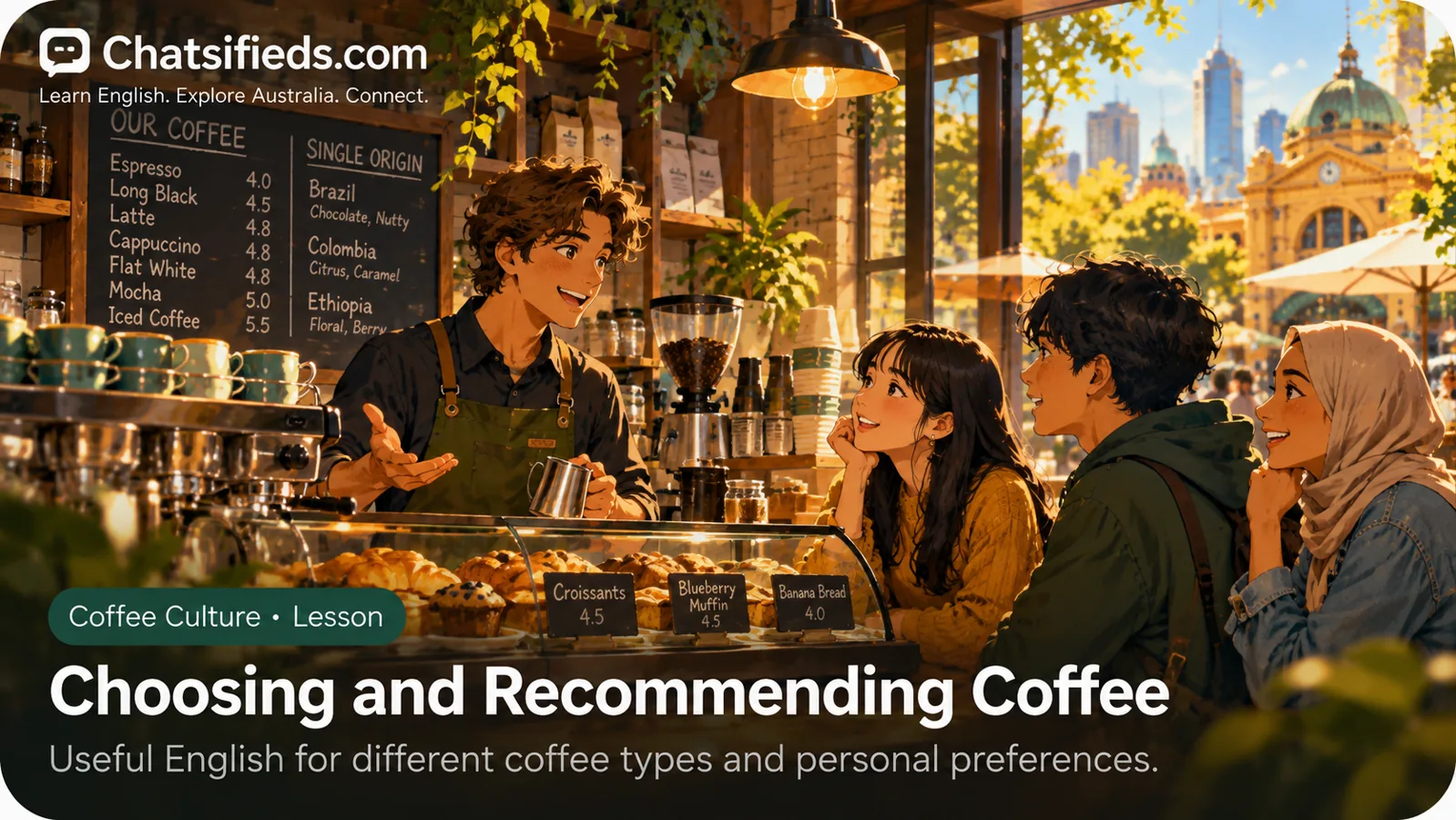
Updated 16/10/2026 · Educational guide
Quick answer
A recommendation is more helpful when you describe what you enjoy: strong or mild coffee, black or milk-based drinks, sweet or less sweet flavours.
Understand the Australian context
Coffee flavour descriptions are subjective. A barista may suggest a house blend, single origin or filter coffee. Ask a follow-up question if you do not recognise a term.
Words to recognise
- house blend
- a mix of coffees selected for a café's flavour profile
- single origin
- coffee presented as coming from one identified origin
- body
- the perceived weight or texture of coffee
- acidity
- bright or lively taste, not necessarily a sour fault
Conversation practice
Customer: What would you recommend if I like mild coffee?
Barista: Our house blend works well with milk.
Customer: Thanks. Is it more chocolatey or fruity?
Barista: It's more chocolatey.
Customer: I'll try a flat white, please.
A longer conversation: choosing a coffee and giving feedback
Customer: Hi. I'm not sure what to order. Could you help me choose?
Barista: Of course. Do you usually drink coffee with milk or black?
Customer: Usually with milk. I like something smooth, not too bitter.
Barista: Then a latte or a flat white might suit you. Do you like a stronger or milder taste?
Customer: Milder, I think. Can I ask what beans you're using today?
Barista: Sure. We have a medium roast blend, and there's also a single origin on filter.
Customer: Is the blend sweet or fruity? I don't mind a little sweetness.
Barista: It's got a nutty, caramel kind of taste. Many people find it gentle.
Customer: That sounds good. Could I get a small size, please?
Barista: No problem. A small latte coming up.
Customer: Thanks. Actually, could I try a little taste of the filter first?
Barista: Of course. Here's a small sample. Let me know what you think.
- "Not too bitter" is a useful way to describe taste without needing technical words. You can also say "not too sweet" or "not too strong".
- "Could I try a little taste?" is a polite request. Not every café can offer a sample, so be ready to accept "Sorry, we can't today."
- "Many people find it gentle" shows the barista is giving an opinion, not a fact. Flavour is personal, so your taste may be different.
More useful phrases
- I like something smooth.
- I prefer a coffee that is not harsh or sharp.Use it: When you describe your taste preference.
- Do you have anything a bit lighter?
- Do you have a milder or less intense option?Use it: When your first choice sounds too strong.
- What roast is this?
- How dark or light were the coffee beans roasted?Use it: When you want to know more about the beans.
- Is that black or with milk?
- Is this coffee served without milk or with milk?Use it: When you are checking how a drink is made.
- Could I have a smaller size?
- Can I order the smallest or a smaller cup?Use it: When you want to try a new drink without ordering a big one.
- It wasn't quite to my taste, but thank you.
- I did not enjoy it very much, but I appreciate your help.Use it: When you politely give feedback after trying a recommendation.
Common mistakes and better ways to say it
Less helpful: “Give me the best coffee.”
Try instead: “What would you suggest for someone who likes mild coffee?”
People enjoy different flavours, so describing your taste helps more than asking for the best.
Less helpful: “This coffee is bad.”
Try instead: “It's a bit stronger than I expected. Do you have something milder?”
Describing your experience is polite and helps the barista find a better option.
Less helpful: “Make it normal.”
Try instead: “Could I have a medium flat white with regular milk?”
"Normal" is unclear, but the size, drink and milk type are easy to understand.
Less helpful: “I don't know these words, so I won't ask.”
Try instead: “Sorry, what does single origin mean?”
Baristas are usually happy to explain, and asking helps you learn.
Talking about taste kindly
Taste is personal. A drink that one person enjoys may seem too strong, too sweet or too sharp to another person. Because of this, a barista's suggestion is an opinion based on what you tell them. The more clearly you describe what you like, such as mild, nutty or not too bitter, the easier it is for them to help.
If you try something and do not enjoy it, it is fine to say so politely. A short comment like "It's not quite for me" is enough. You can then ask for something different next time. Keep in mind that a café may not be able to replace a drink, so be ready to ask and accept a polite answer either way.
Advertisement
Try it yourself
Describe three flavour preferences, then ask two polite follow-up questions.
Phrase Wall practice: use this phrase
What would you recommend?
Say the example aloud, then try it in a real conversation. Discover more useful phrases and save your favourites to My Learning.
Quick check
Think about each answer first, then open “Show answer”. This is a self-check, not a scored quiz.
1. Which sentence best describes a taste preference?
- Give me the best coffee.
- I like something smooth and not too bitter.
- Make it normal.
Show answer
Answer: B. I like something smooth and not too bitter. It describes a taste clearly, so the barista can suggest something suitable.
2. You want to try a new drink without ordering a lot. What can you ask?
- Could I have a smaller size?
- Could I have a bigger bill?
- Could I have no cup?
Show answer
Answer: A. Could I have a smaller size? Asking for a smaller size is a simple, polite way to try something new.
3. What does "What roast is this?" ask about?
- How hot the coffee is
- How the beans were roasted
- How much the coffee costs
Show answer
Answer: B. How the beans were roasted The roast describes how dark or light the beans were roasted.
4. You did not enjoy a drink. What is the most polite thing to say?
- This is terrible.
- It wasn't quite to my taste, but thank you.
- Nothing, and never come back.
Show answer
Answer: B. It wasn't quite to my taste, but thank you. It is honest and kind. It also thanks the barista for helping.
Frequently asked questions
Is there one best coffee for everyone?
No. Taste is personal, so the best coffee is the one you enjoy. Describing what you like helps the barista suggest something suitable.
Can I ask to try a taste before I order?
You can ask politely, but not every café can offer one. If the answer is no, you can ask for a smaller size instead.
What if I do not understand a coffee word?
Ask a simple question such as "Sorry, what does that mean?" Baristas are used to explaining terms to customers.
Can I tell the barista I did not enjoy my drink?
Yes, if you are polite. Say what you noticed, such as "a bit too strong for me", and ask if there is something milder next time.
Keep exploring
See it in a real Australian story
Chatsifieds Phrase Wall
Take two useful phrases into real Australian conversation.
Practise these related phrases, learn what they mean and build confidence before you use them in real life.
Phrase Wall & local business learning
Practise this English in real life
Explore useful Australian English on the Phrase Wall. Relevant businesses can support this lesson with a clearly labelled student offer or real-world practice opportunity.
Sponsorship is clearly labelled and never changes educational answers. Sponsored content policy.
Continue learning on Chatsifieds
- Coffee Culture hub
- Phrase Wall
- flat white cafe english australia
- australian cafe english glossary a to z
- Meeting Someone at an Australian Café: English from Invitation to Goodbye
- When an Australian Café Is Busy: English for Queues, Waiting and Tables
- Coffee Taste Vocabulary: Strong, Smooth, Bitter and Fruity
- Flat White vs Latte vs Cappuccino: ESL Coffee Guide
Independent reference sources
The following educational or coffee-industry sources provide context; they are not paid partner links.