
1. Notice
Read the menu or listen for the key word in context. Do not try to translate every sentence. Identify the choice the staff member needs from you.
In a busy cafe, words can blend together. Learners may know the vocabulary on paper but not recognise it at normal speaking speed.
Quick answer
Natural speech often reduces unstressed words. Anything else? can sound much shorter than the careful classroom version. Here or takeaway? may be delivered as one quick rhythm. The goal is recognition, not copying every reduction.
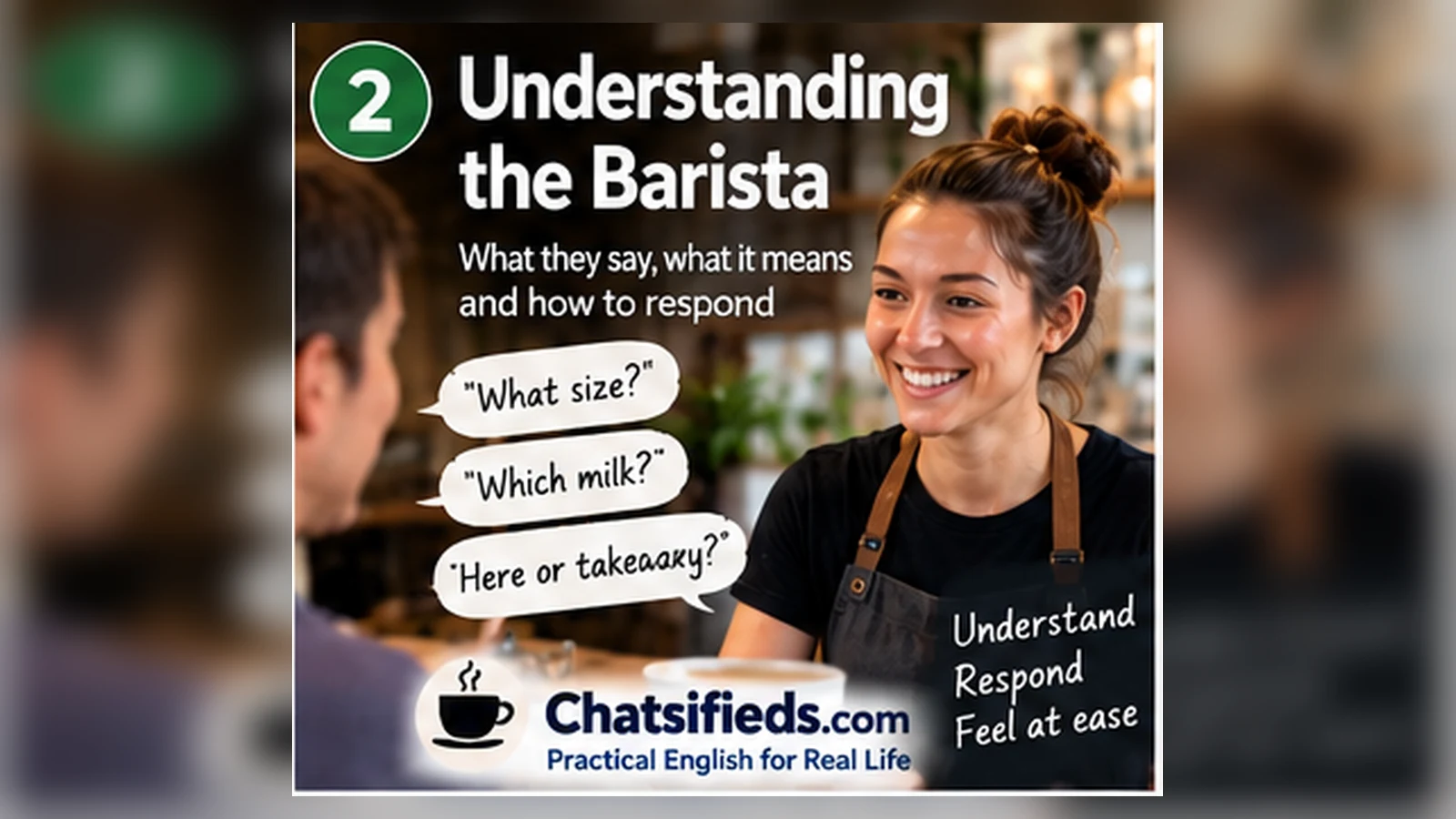
Listen for anchors: size, milk, here, takeaway, else, name, card. Context does a lot of the work. You can answer once you identify what choice the barista needs.
Slow English is useful for learning. Natural English is useful for real life. You need both, but you never need to force an Australian accent.
Build the skill
Read the menu or listen for the key word in context. Do not try to translate every sentence. Identify the choice the staff member needs from you.
Use a short, clear answer first. Add please or thanks where it sounds natural. If the detail matters, ask one specific follow-up question rather than guessing.
If you miss the question, say, Sorry, could you say that again? Real communication includes checking, repeating and correcting. That is a skill, not a failure.
Australian cafe English is flexible. Menus, accents, recipes and service systems vary, so learn the core vocabulary and the clarification phrases together. That combination lets you handle a new cafe even when the exact wording is different from this lesson.
Speak naturally
Vocabulary
Listening practice
Listen for else: do you want another item?
Listen for here and takeaway: where will you have it?
Listen for milk: repeat the milk choice.
Listen for name: give a name to call.
Real dialogue
Common learner mistake
A common mistake is pretending you understood because you feel embarrassed. Asking once more is normal and usually faster than fixing a wrong order.
Try it for real
Play a cafe video or stand near a counter where you can hear normal service language without recording anyone. Write down three anchor words you recognise.
Quick check
No. Speed varies by person, place and how busy the cafe is.
Only if it feels natural. Understanding matters more than imitation.
No. A short polite clarification is normal.
FAQ
No. Speed varies by person, place and how busy the cafe is.
Only if it feels natural. Understanding matters more than imitation.
No. A short polite clarification is normal.
Listen for choice words such as milk, size, here, takeaway, name and card.
Read a full question, then say it more quickly while keeping the key words clear.
Chatsifieds Phrase Wall
Every Chatsifieds lesson connects language to real life. Practise these related phrases, learn what they mean and build confidence before you use them in a café, class, workplace or everyday conversation.
Printable practice
Practise the words and phrases from this lesson on paper. The worksheet is made only from lesson material, and teachers can use the answer key and teacher pack.
Related learning
This lesson belongs to a connected Coffee English learning collection. Use the main collection and related lessons to build the idea, the culture and the everyday English together.
Join Speak English Like a Pro on Facebook to practise everyday English, ask questions, share what you are learning and discover new Chatsifieds lessons.