
What is a macchiato?
A macchiato is espresso “marked” with a small amount of milk or foam. It is a small, strong coffee order.
“Could I get a macchiato, please?”
Use this phrase to sound natural, friendly and confident at the counter.
Learn the drink, the culture, and the English phrase travellers and ESL learners can use in real Australian cafés.
A macchiato is espresso “marked” with a small amount of milk or foam. It is a small, strong coffee order. This lesson shares Australian coffee culture while helping you practise polite, everyday English for study, travel, work and social life.
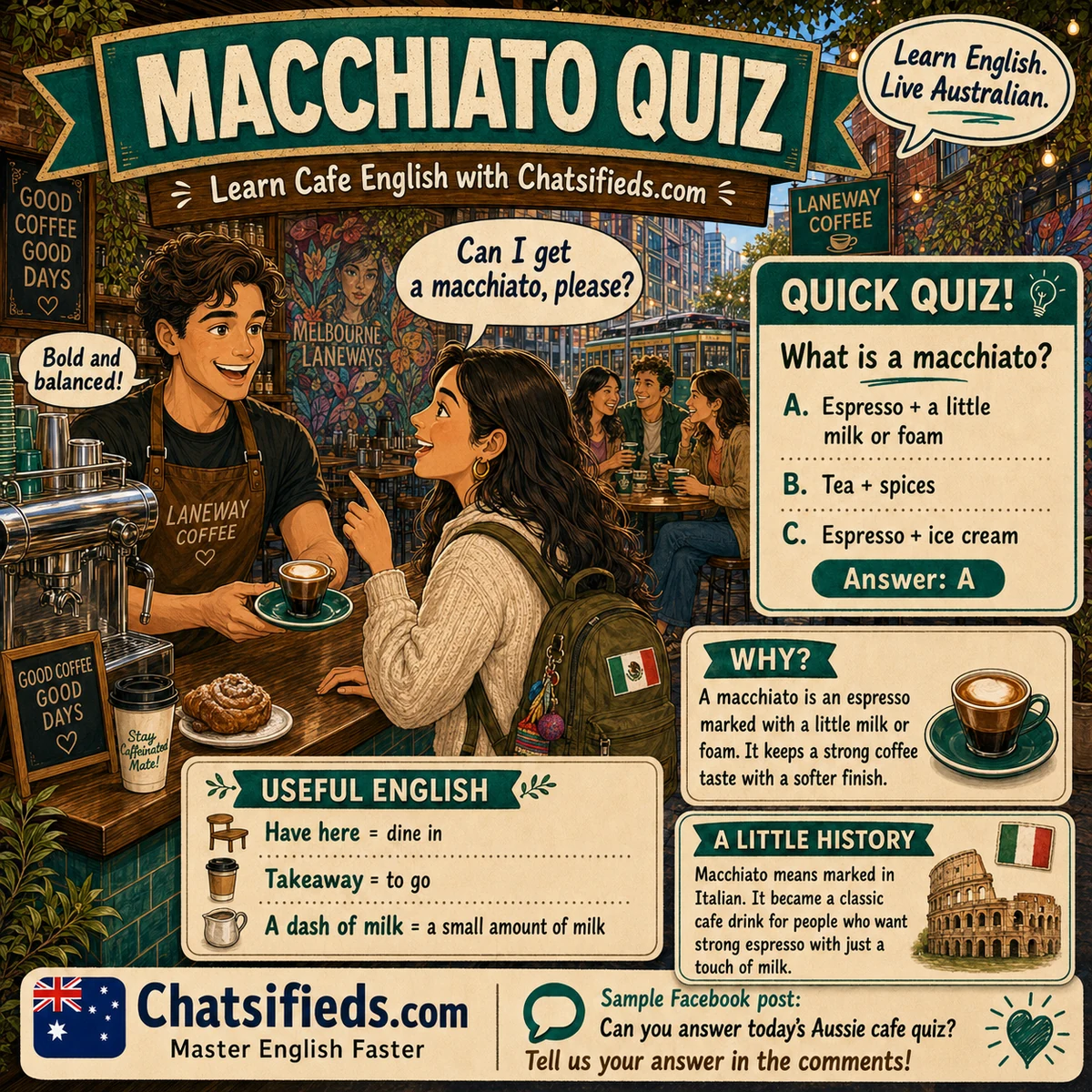
“Your next coffee order can be your next English lesson. Learn one drink, one phrase and one friendly reply.”
Learn what a macchiato is and how to ask for a small espresso with a little milk or foam.
“Could I get a macchiato, please?”
short questions from the barista, such as size, milk, takeaway and payment.
One short polite sentence is enough. You can ask again if you miss a word.
A macchiato is espresso “marked” with a small amount of milk or foam. It is a small, strong coffee order.
“Could I get a macchiato, please?”
Use this phrase to sound natural, friendly and confident at the counter.
Macchiato is useful for advanced café English because the word can be confusing. Learners can practise checking politely: “Is that a short macchiato?” or “How do you make it here?”
This spoke page connects to the main Australian Coffee Culture & Café English hub and helps learners go deeper with one real café order.
Could I get a macchiato, please?
Could I get a macchiato takeaway, please?
Sorry, could you say that again?
| Drink | What it means | Useful English |
|---|---|---|
| Flat White | Espresso with steamed milk and thin microfoam | Can I grab a flat white, please? |
| Long Black | Espresso poured over hot water | Just a long black, thanks. |
| Latte | Espresso with more steamed milk and a light layer of foam | Can I grab a latte, please? |
| Cappuccino | Espresso with steamed milk, thicker foam and often chocolate powder | Could I get a cappuccino, please? |
| Mocha | Espresso with chocolate and steamed milk | Could I get a mocha, please? |
| Iced Latte | Espresso with cold milk and ice | Can I grab an iced latte, please? |
| Chai Latte | Spiced tea drink with steamed milk, usually no coffee | Could I get a chai latte, please? |
| Espresso | Small strong coffee, often called short black | Could I get an espresso, please? |
| Piccolo | Small milk coffee with a stronger taste | Could I get a piccolo, please? |
| Macchiato | Espresso marked with a little milk or foam | Could I get a macchiato, please? |
| Magic Coffee | Melbourne-style small strong milk coffee | Could I try a magic, please? |
A local café, tutor, accommodation provider or student service can own a friendly learning phrase on Chatsifieds. This page is a natural place for a helpful partner card because the lesson teaches real English people use in Australian cafés.
Learn about Own a PhraseThis lesson gives students one real café sentence they can practise, remember and share. The Phrase Wall helps learners collect useful Australian English they can use in everyday life.
Practice phrase“Could I get a macchiato, please?”
For students, this is more than a coffee word. It is a short speaking mission: read the phrase, practise it aloud, listen for the barista's question, answer clearly, and use the same English in a real café.
Australian cafés are often friendly, fast and casual. Staff may ask short questions such as “having here or takeaway?”, “regular or large?”, “any sugar?” or “cash or card?”.
Say the order slowly first, then naturally. A good learner sentence for this topic is:
“Could I get a macchiato, please?”
When you visit a café, use one new phrase. If you do not understand, smile and say, “Sorry, could you say that again?” That is natural English, not a mistake.
Australian café English can sound quick because people use short, friendly phrases. These words help learners understand the rhythm of local coffee culture.
A casual way to order. “Can I grab a latte?” means “Can I have a latte?”
A friendly Australian reply. It can mean “that's okay”, “sure”, or “you're welcome”.
Coffee you carry with you. In Australia this is more common than saying “to go”.
A casual “thanks”. Students can still use “thank you” if they want to sound more formal.
The Phrase Wall helps students practise useful English before they walk into a café. A local business can sponsor a phrase, add a discount code, and welcome learners with a simple mission such as “Say the phrase at the counter and save”.
Students learn the meaning, practise pronunciation, then use the phrase confidently when ordering.
Place your café on a learning moment, not just an ad. Add your logo, offer, menu link, booking link or discount code so learners know where to practise.
Good offers include “show this phrase for 10% off”, “student coffee combo”, or “free size upgrade with the practice phrase”.
Students do not just read the phrase — they use it. A café can own this practice phrase and turn it into a discount code, ordering prompt, or in-store reward.
Use this mission when you visit a featured café or order online.
Dedicated learning moment: business name, logo, offer, image or short video connected to the phrase.
Measurable action: track phrase use, menu clicks, order clicks or in-store redemptions.
A macchiato is usually an espresso “marked” with a small amount of milk or foam. In Australian specialty cafés, it is normally a small strong drink, not a large sweet caramel drink.
The most useful sentence to practise is: “Could I please have a macchiato?” This sounds polite, clear and natural at the counter. You can add “to take away”, “to have here”, “with oat milk”, “regular”, “large”, or “extra hot” after the drink name.
Start with “Can I please have…” or “Could I please get…”. Both are friendly and common in Australian cafés.
Do not assume a macchiato is sweet. Ask the barista if you are unsure, because café styles can vary.
If you are not sure, ask: “What is the difference between this and a latte?” That is a normal question in a café, and it gives you real listening practice.
An Australian café macchiato is usually much smaller and stronger than the sweet macchiatos sold by some international chains.
Use this page as part of the full Chatsifieds.com café English series. Follow the beginner path first, then practise popular drink names and real conversations.
Score 8 out of 10 or higher to unlock your printable Chatsifieds certificate. One attempt per question — choose carefully!
0 of 10 answered
Q1 · Meaning
Q2 · Ordering
Q3 · Takeaway
Q4 · Drink Detail
Q5 · Compare
Q6 · Milk Choice
Q7 · Listening
Q8 · ESL Practice
Q9 · Small Talk
Q10 · Confidence
A macchiato is usually an espresso “marked” with a small amount of milk or foam. In Australian specialty cafés, it is normally a small strong drink, not a large sweet caramel drink.
Say, “Could I please have a macchiato?” You can also add the size, milk choice and whether it is to take away or to have here.
Yes. Macchiato is a useful café word to know, especially for learners practising everyday English in Australia cafés.
An Australian café macchiato is usually much smaller and stronger than the sweet macchiatos sold by some international chains.
Say, “Sorry, could you say that again?” or “Sorry, what does that mean?” These are polite, natural sentences for learners.
Complete the Macchiato quiz and score 8 out of 10 or higher. Then enter your name and print the Chatsifieds certificate.
Chatsifieds Phrase Wall
Every Chatsifieds lesson connects language to real life. Practise these related phrases, learn what they mean and build confidence before you use them in a café, class, workplace or everyday conversation.
New in the expanded Coffee Culture series
Keep the core skill you just learned, then connect it to listening, culture, menu English or a real-life cafe mission.
For stronger speaking confidence, connect this page with the ordering cheat sheet, A to Z glossary, pronunciation guide, common mistakes guide and the main coffee hub.
Continue the coffee learning path
Return to the hub for the complete guided pathway, or continue to a closely connected lesson.
Join Speak English Like a Pro on Facebook to practise everyday English, ask questions, share what you are learning and discover new Chatsifieds lessons.