
Australian Coffee Culture · Real-life English
When an Australian Café Is Busy: English for Queues, Waiting and Tables
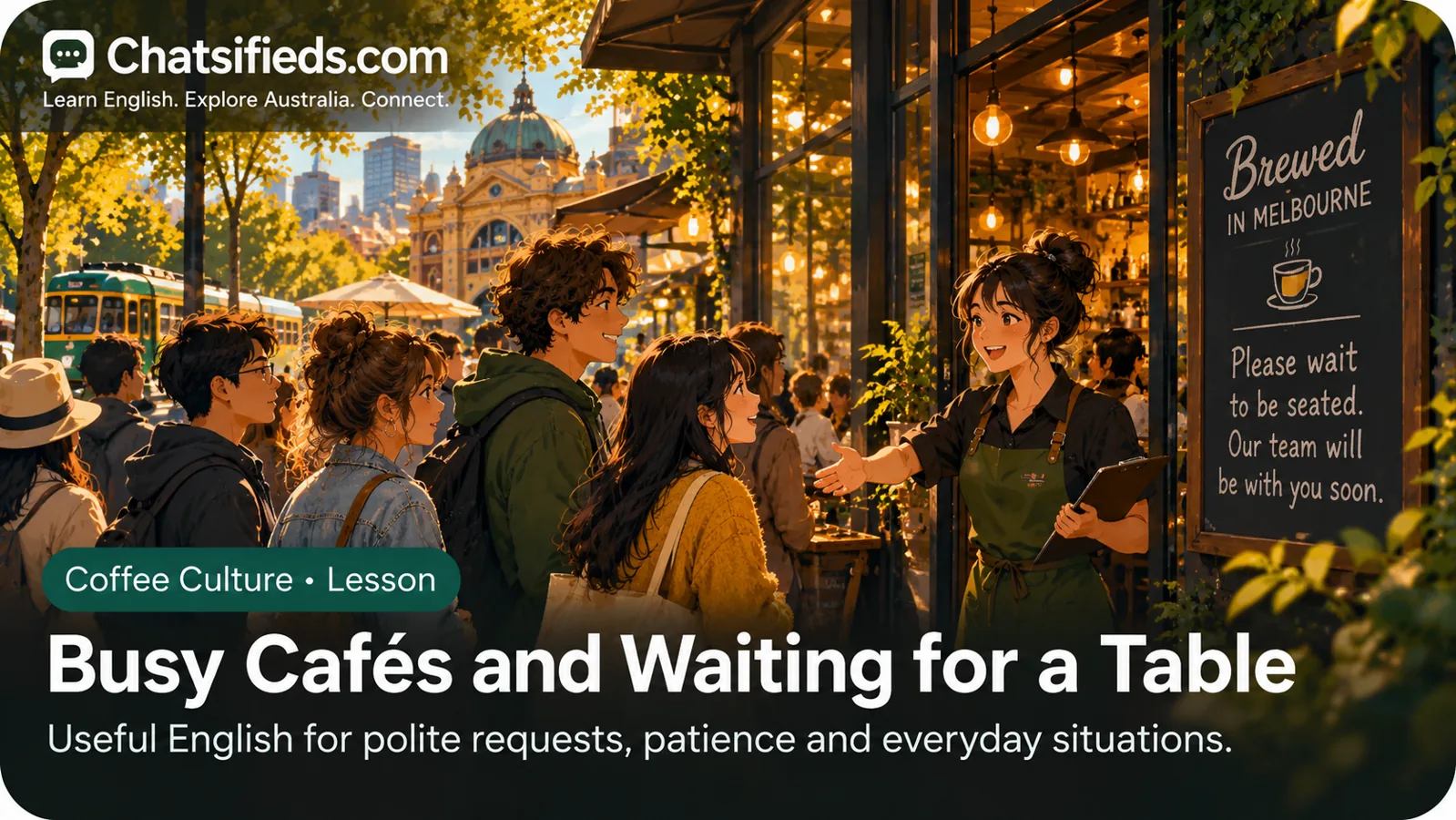
Learn how to ask about waiting times, tables, queues, bookings and counter service at a busy Australian café.
Updated 16/10/2026 · Educational guide
Quick answer
Some cafés offer table service, others ask you to order at a counter or use a table number. A busy café may change how customers are seated or served.
Understand the Australian context
Look for instructions at the entrance and ask staff what to do. When a venue is full, ask about the expected wait without demanding a precise promise.
Words to recognise
- fully booked
- all bookable tables are reserved
- walk-in
- a customer arriving without a booking
- waitlist
- a list of people waiting for a table
- counter service
- order at the counter rather than at your table
Conversation practice
Customer: Hi, is there a table for two?
Staff: We're quite busy. There's about a twenty-minute wait.
Customer: Thanks. Can we put our names down?
Staff: Yes. May I have a name, please?
A longer conversation: arriving at a busy café with a friend
Customer: Hi there. Do I need to wait to be seated, or can we choose a table?
Staff: Good question. Please wait here and I'll check for you.
Customer: Thank you. Do you know roughly how long it might be?
Staff: Probably about fifteen minutes, but it can change.
Customer: That's fine. Is it okay if we wait outside?
Staff: Of course. I'll call your name when a table is ready. What's your name, please?
Customer: It's Sam. Can we look at the menu while we wait?
Staff: Sure, here you go. You can order at the counter once you're seated.
Customer: Great, thanks. So I order at the counter and pay there?
Staff: Yes, that's right. Just remember your table number.
Customer: Understood. Is it all right to sit here for a moment?
Staff: No problem. Thanks for your patience.
- "Roughly how long might it be?" asks for an estimate. The word "roughly" shows you understand that the answer is not a promise.
- "I'll call your name" means the staff will say your name out loud when a table is ready. Stay close enough to hear it.
- "Thanks for your patience" is a common thing for staff to say when customers wait. A simple "No worries, thanks" is a good reply.
More useful phrases
- Do we order at the counter or at the table?
- Do we speak to staff at the front desk, or will someone come to us?Use it: When you are not sure how a café works.
- Do you take bookings?
- Can I reserve a table in advance?Use it: When you want to plan a visit for another day.
- I have a booking under Lee.
- A table was reserved with the name Lee.Use it: When you arrive for a reserved table.
- Would you mind letting us know if something opens up?
- Please tell us if a table becomes free.Use it: When you are waiting and want to be polite.
- Is it okay if we share a table?
- May we sit at a table with other people?Use it: Only if the venue has shared tables and you feel comfortable. Ask staff first.
- Is that order for table seven?
- Is this food or drink for table number seven?Use it: When staff bring something and you want to check it is yours.
Common mistakes and better ways to say it
Less helpful: “How long? Tell me exactly.”
Try instead: “Roughly how long do you think the wait might be?”
Busy cafés cannot always be exact, so asking for an estimate is more polite.
Less helpful: “I'll just sit anywhere.”
Try instead: “Is it okay to choose a table, or should we wait to be seated?”
Some venues seat customers and some do not, so checking avoids confusion.
Less helpful: “Why is my order so slow?”
Try instead: “Sorry to bother you, could you check on our order for table five?”
A polite request with the table number is clear and gives staff what they need.
Less helpful: “Move, I want to sit here.”
Try instead: “Excuse me, is anyone sitting here?”
Asking calmly respects other people and lets them answer.
Reading the room in a busy café
Cafés work in different ways. At some, staff seat you and take your order at the table. At others, you order and pay at the counter, then take a table number or find a seat. Signs near the door or counter often explain the system, but if you are unsure, a short question to a staff member is welcome.
When a café is busy, staff are often doing several jobs at once. Use a calm voice, wait for a good moment to ask your question, and be ready to hear "It might be a while." If you cannot wait, you can say thank you and try another place. Sharing a table is only suitable if the venue offers it and you feel comfortable.
Advertisement
Try it yourself
Practise arriving without a booking, confirming service style and deciding whether to wait.
Phrase Wall practice: use this phrase
Is there a table for two?
Say the example aloud, then try it in a real conversation. Discover more useful phrases and save your favourites to My Learning.
Quick check
Think about each answer first, then open “Show answer”. This is a self-check, not a scored quiz.
1. You are not sure how a café works. What is a good first question?
- Do we order at the counter or at the table?
- Why is nobody serving me?
- Where is my coffee?
Show answer
Answer: A. Do we order at the counter or at the table? It is polite and clear, and it helps you learn how that venue operates.
2. Which question asks about waiting time without demanding a promise?
- Tell me exactly how many minutes.
- Roughly how long might the wait be?
- You must seat us in ten minutes.
Show answer
Answer: B. Roughly how long might the wait be? The word "roughly" shows you understand that the time is only an estimate.
3. You made a reservation. What do you say on arrival?
- I have a booking under Lee.
- I am a walk-in.
- Is there a waitlist?
Show answer
Answer: A. I have a booking under Lee. A reservation is a booking, so you give the name it was made under.
4. When is it appropriate to ask to share a table?
- Always, in every café
- Only when the venue offers shared tables and you are comfortable
- Never, in any café
Show answer
Answer: B. Only when the venue offers shared tables and you are comfortable Some venues have shared tables, but others do not. It also depends on your own comfort, so check with staff.
Frequently asked questions
What is the difference between a booking and a waitlist?
A booking reserves a table for a set time in advance. A waitlist is a list of people who arrived and are waiting for the next free table.
What if I do not want to wait?
You can say, "Thanks, we'll try somewhere else." That is polite and clear. Staff usually understand when a customer cannot wait.
What is a table number used for?
In many cafés, staff give you a number to place on your table. This helps them bring your food or drinks to the right place.
How do I ask about my order if it feels slow?
Wait for a quiet moment and say, "Sorry to bother you, could you check on our order?" Mention your table number or name to help the staff.
Chatsifieds Phrase Wall
Take a useful phrase into real Australian conversation.
Practise this phrase, learn what it means and build confidence before you use it in real life.
Phrase Wall & local business learning
Practise this English in real life
Explore useful Australian English on the Phrase Wall. Relevant businesses can support this lesson with a clearly labelled student offer or real-world practice opportunity.
Sponsorship is clearly labelled and never changes educational answers. Sponsored content policy.
Continue learning on Chatsifieds
- Coffee Culture hub
- Phrase Wall
- australian cafe etiquette international students
- having here or takeaway cafe english australia
- Meeting Someone at an Australian Café: English from Invitation to Goodbye
- How to Ask an Australian Barista for a Coffee Recommendation
- Still Waiting? Missing Item Café English
- Your Coffee Is Ready: Pickup and Collection English
Independent reference sources
The following educational or coffee-industry sources provide context; they are not paid partner links.